
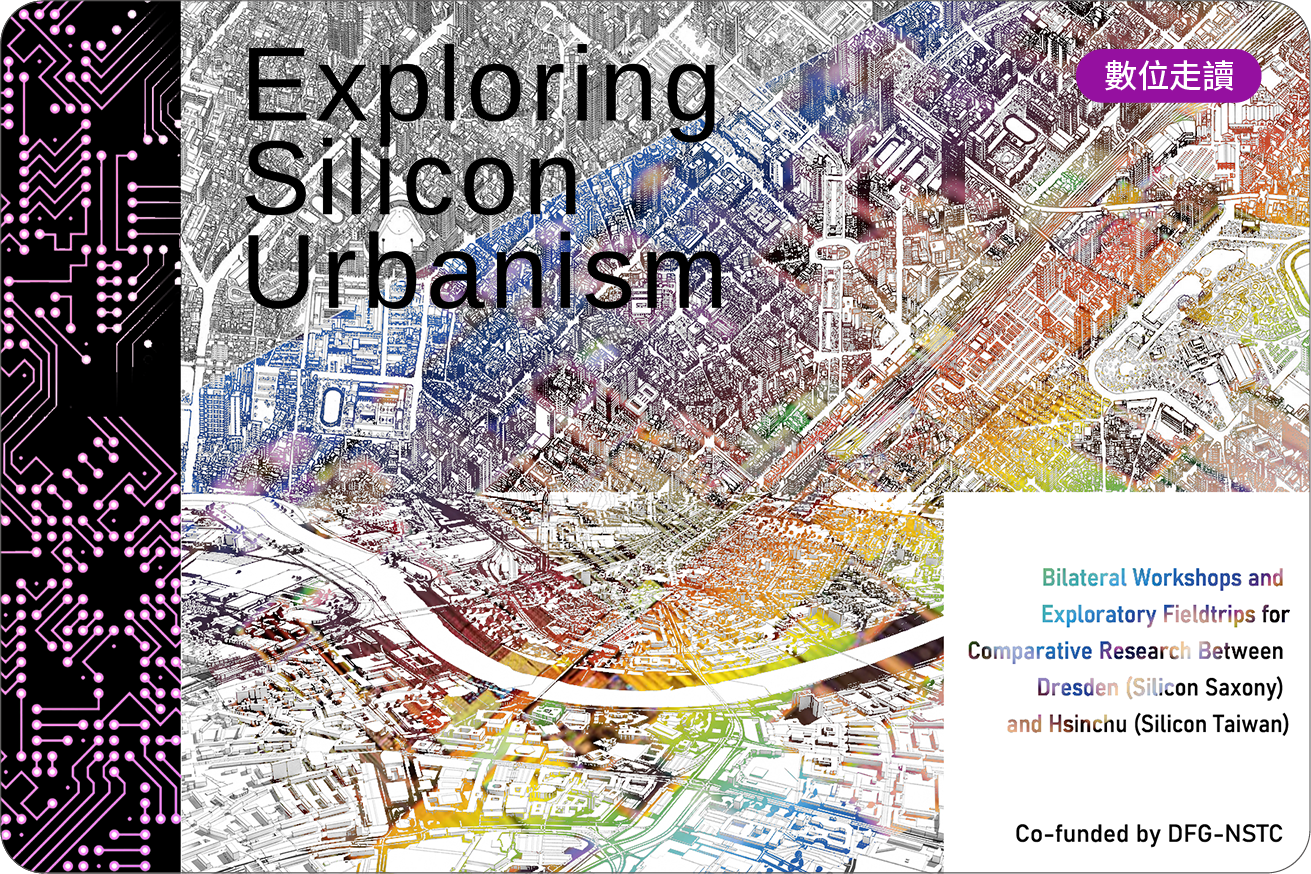
德勒斯登晶片城市走讀
晶片在德勒斯登-薩克森州的基礎設施化進程:以走讀工作坊分層閱讀,重啟問題空間
新竹的走讀工作坊(walkshop)讓我們認識到,晶片產業並非只是「對」城市與區域發展產生影響。在人工智慧加速發展、各國於技術主權上的地緣政治競爭日益激烈的時代,晶片如同任何基礎設施一般,其本身即構成一種影響力。它既是物質性的,徵用了原料、化學品、水、電力、土地、設備與資料中心;也同時是社會性與關係性的,在實驗室、大學、國家機構、既有大廠與新創之間,鍛造出新的專業知識與新的合作聯盟。作為基礎設施,晶片有其獨特之處:它不像道路、水壩或管線那般直白呈現,其基礎設施空間高度分散且高度壓縮,被封裝、黑箱化。它存在並顯現於極度複雜的無塵室、技術許可、標準化的 ESG 指標與抵換實踐,以及將在地到全球的勞動力輸送進晶圓廠的人才管線之中。
德勒斯登讓我們得以撬開這個黑箱。正如新竹是由清代聚落、日治時期基礎設施、國民政府產業政策,乃至科學園區層層疊寫而成的重寫本(palimpsest),德勒斯登同樣不是一座突然「變成」晶片城市的城市,而是一座一再被選擇、被層層疊加於更古老基底之上的晶片城市。在晶圓廠之下,沉積著百年來精密光學、材料科學與精密機械的文化,這一傳統清晰可見於德勒斯登技術博物館(Technische Sammlungen)所陳列的相機與儀器製造之中。其上則是 VEB Robotron 與德勒斯登微電子中心(Zentrum Mikroelektronik Dresden)的社會主義微電子篇章,那是東德為追趕西方所付出高昂代價、卻引以為傲的努力;接著是一九九〇年後的轉折:西門子與 AMD 正是看中德勒斯登殘存的技術人才基礎而選擇落腳於此,催生了我們今日所造訪的北部產業帶,即 GlobalFoundries、Bosch 與 ESMC。而在這一切之下,是由易北河(Elbe)及其北側的台地與岩盤所代表的深層時間,承托起這些晶圓廠。在其之上,易北河谷上行駛著薩克森的明輪蒸汽船,那是十九世紀初機械工程的傑作;坡地則承載著巴洛克花園,以及德國第一座田園城市海勒勞(Hellerau)。在海勒勞,里默施密德(Riemerschmid)曾將工廠、工人住宅與社區編織成單一的綠色有機體。這些新舊地基將如何承載德勒斯登晶片的新生態?
走讀工作坊正是我們所採取的方法,一場重啟問題空間的「解壓縮」實踐。在水平方向上,我們沿著分散於全城的基礎設施前行:從實驗室、晶圓廠到自來水與汙水處理廠,從生態抵換用地到即將安置新進人才的社區。在垂直方向上,我們解壓縮被二〇二三年晶片熱潮敘事所壓平的時間層理與意義,追問:誰來許可、誰能獲利、誰被迫遷離、什麼被記住、什麼又被拆除。
我們由此也探問德勒斯登的獨特之處:它既非加州的創投資本主義,亦非台灣發展型國家式的高強度動員,而是一種歐洲式的、受到規管且在公民社會中備受爭議的版本。舊萊比錫車站(Alter Leipziger Bahnhof)由下而上的再開發、搶救 Robotron 員工餐廳(Robotron-Kantine)的長期抗爭、ZfBK(薩克森建築文化中心)的建築文化(Baukultur)辯論、Bauwende Sachsen 的循環營建行動者,以及大學與職業訓練體系的重整與國際化,這些都不是晶片熱潮的註腳,而是一個民主的、承載記憶的、一度边缘并正在國際化的社會藉以讓問題空間保持開放的方式。
Infrastructuring the Chip in Dresden-Saxony: Reopening the Problem-Space through Walkshop
Our walkshop in Hsinchu taught us that the chip industry does not simply have an impact on urban and regional development. In an age of accelerating AI and intensifying geopolitical competition over technological sovereignty, the chip, like any infrastructure, is itself an impact. It is at once physical, conscripting materials, chemicals, water, electricity, land, devices, and data centers, and at the same time social and relational, forging new forms of expertise and new alliances among laboratories, universities, national institutions, incumbents, and startups. Yet as infrastructure the chip is peculiar. Where a road, a dam, or a pipeline announces itself, the chip's infrastructural space is radically distributed and compressed, black-boxed inside hypercomplex cleanrooms, technical permits, standardized ESG metrics and offsets, and talent pipelines that channel local-to-global labor into the fab.
Dresden lets us pry that black box open, because it is not a city that became a chip city but one onto which microelectronics has been repeatedly grafted, each layer onto an older substrate, much as Hsinchu is a palimpsest of Qing settlement, Japanese-era infrastructure, KMT industrial policy, and the Science Park. Beneath the fabs lies a century-old culture of precision optics, materials science, and fine mechanics, legible in the camera and instrument works of the Technische Sammlungen. Above it sits the socialist microelectronics episode of VEB Robotron and the Zentrum Mikroelektronik Dresden, the GDR's costly, proud bid to keep pace with the West, followed by the post-1990 pivot, when Siemens and AMD chose Dresden for its residual skill base and seeded today's northern belt at GlobalFoundries, Bosch, and ESMC. Beneath all of it lies the deep time of the Elbe and the northern terraces and bedrock that ground the fabs; the valley plied by the Saxon paddle steamers, a triumph of early nineteenth-century engineering; and the slopes that carry the Baroque gardens and, at Hellerau, Germany's first garden city, where Riemerschmid wove factory, workers' housing, and community into a single green organism. How will these old and new foundations host the new ecologies of the chip in Dresden?
The walkshop is our counter-method, an exercise in decompression that reopens the problem-space. Horizontally, we follow the distributed infrastructure across the city, from labs and fabs to waterworks, from offset fields to the neighborhoods that will house incoming talent. Vertically, we decompress the temporal strata and meanings that the 2023 chip boom story flattens, asking who permits, who profits, who is displaced, what is remembered, and what is demolished.
We thereby also inquire into what makes Dresden distinctive: neither California's venture capitalism nor Taiwan's developmental-state intensity, but a European, regulated, civically contested variant. The bottom-up redevelopment of the Alter Leipziger Bahnhof, the fight to save the Robotron-Kantine, the Baukultur debates at the ZfBK, the circular-building activists of Bauwende Sachsen, and the rewiring and internationalization of the university and vocational training system are not footnotes to the boom. They are the means by which a democratic, memory-laden, once marginalized but internationalizing society keeps the problem-space open.
13